Dear friends,
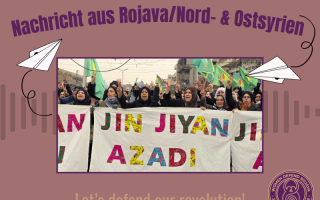
Once again this week, the issue of the ‘right to one’s mother tongue’ is at the heart of civil society protests in Rojava.
Pupils, families and teachers continue to raise their voices to defend the right to be taught in the Kurdish language – in response to the decision to limit Kurdish language lessons to three lessons per week. Through various protests in Qamishlo, Heseke and many other towns across the region, pupils have expressed their determination to continue learning in their mother tongue, emphasising that the Kurdish language is not merely a school subject, but an essential part of their identity, culture and future. After years of building up an education system in the Kurdish language, the pupils refuse to allow their right to be taught in their own language to be reduced to a limited slot in the timetable.
Against the backdrop of the ongoing protests, a wide range of stakeholders have spoken out on the issue of the mother tongue. For instance, teachers affiliated with the school administration and the Academy for Educational Research organised a workshop in the city of Qamishlo entitled ‘Our Language is Our Civilisation’. In a press statement, Kongra Star emphasised that whilst the inclusion of Kurdish in the curriculum is a step forward, it does not in itself guarantee the unrestricted right to education in the mother tongue. The organisation is calling for a stronger presence of Kurdish in educational institutions, as well as constitutional and legal protection of linguistic and cultural rights. In a message to the pupils and their families, the Syrian presidential adviser Mazloum Abdi emphasised that education in one’s mother tongue is a fundamental and natural right, and reaffirmed the ongoing efforts towards the official recognition of the Kurdish language.
New steps towards the return of displaced families from Serekaniye
Efforts to facilitate the return of internally displaced families from Serekaniye to their home villages are continuing. Preparations are currently under way for a third repatriation convoy, in which more than 500 families from emergency shelters and schools will take part. So far, 700 families (approximately 7,000 people) have already been able to return to their villages. After years of displacement, these returns mean more than just a journey from one place to another. They reflect the displaced families’ enduring connection to their homeland, as well as their right to return, rebuild their lives and regain the stability that has been denied them for so many years.
Women’s economy, cooperatives and international networking
A delegation from the Women’s and Mixed-Gender Economic Committees of North-East Syria, which are driving forward the development of cooperatives in Rojava, attended the 2026 World Conference of the International Cooperative Alliance in Panama last week. The theme of the conference was: ‘Building Bridges: Cooperative Contributions to a Peaceful World’. The delegates used the conference to share their experiences of setting up coops and to discuss the current situation of co-operatives in the integration process. They were also able to forge international contacts and strengthen dialogue on opportunities and support for sustaining co-operatives in Rojava, and in particular the women’s economy. Alongside the conference, it was possible to visit local coops in Panama and exchange experiences regarding a cooperative economy and the role of women within it.
As the struggle for rights, freedom and peaceful, democratic coexistence continues, we send you revolutionary greetings from Rojava!